Difference between revisions of "911:Secret services"
From Wiki
Jump to navigationJump to searchCommendatori (talk | contribs) |
Commendatori (talk | contribs) |
||
| Line 156: | Line 156: | ||
* See also: | * See also: | ||
** "[http://statismwatch.ca/2010/12/08/be-seeing-you-the-coming-surveillance-expansion/Be Seeing You: The Coming Surveillance Expansion]" | |||
** "[http://ec.europa.eu/enterprise/security/doc/fp7_project_flyers/adabts.pdf EU project: Adabts]" | ** "[http://ec.europa.eu/enterprise/security/doc/fp7_project_flyers/adabts.pdf EU project: Adabts]" | ||
Revision as of 12:47, 5 August 2011
Site menu:
- Occult symbolism Intro
- History of oppression
- Social terrorism
- Economic terrorism
Intro
- See also:
History
- Quote from Ignatius, Spying and Sedition-From A Work in Progress
- Prior to his journey across the English Channel, on his first begging journey to Bruges and Antwerp, Loyola encountered a Spaniard of high repute and learning. “He met at Bruges the Spanish humanist Juan Luis Vives, who had recently returned from his post in England.” (The Society of Jesus in Ireland, Scotland and England 1541-1588 by Thomas M. McCoog. Page 12, published by Brill, 1996.) Vives was a professor at the Louvain who had come to England at the invitation of Henry, acted as tutor to Princess Mary (later “Bloody Mary”), but was forced to leave England because he had declared himself against the divorce of Catherine of Aragon. (Encyclopedia Britannica,11th Edition, Handy Edition, 1911, Vol. 28, Pages 152-153.) This Spanish Papist was a connection for Ignatius to the Spaniards in England. He was an excellent Catholic role model for Ignatius, having produced a most bigoted and fanatic, religious murderess in his education of Mary. His up to date knowledge of England, together with letters of introduction from him would have provided open doors for Loyola throughout all strata of Catholic and Spanish society in England. Ignatius also would have been easily able to serve as a courier, bringing messages in and then gathering information for his Lord, the Pope. The beginning of Jesuit espionage and counterintelligence began with the founder of the Order, a calculating militarist who well understood the importance of reconnaissance, logistics and planning.... The early training of Loyola would later bear fruit in the spiritual surveillance, physical espionage, and a “human resource” inventory system that was developed within the Society. “The detective system which prevails to so iniquitous an extent amongst the Jesuits must prevent friendship by destroying mutual confidence"... Full dictatorial surveillance based on the Jesuit model was openly implemented in Western Europe under the Gestapo, and this was improved and expanded upon to control and permeate the intelligence agencies of all nations. It has birthed as well a fraternity of men who have demonstrated the ability to amass the wealth of the nations in heaps and piles across the globe for use to achieve the designs for world domination.
- Quote from Eric Jon Phelps on the Middle East:
- "Before commencing the body of this text, the author recommends the reading of his book, "Vatican Assassins: Wounded In The House Of My Friends”. Therein, the reader will be informed, fact-by-fact, as to the origin and perfection of the Jesuit Superior General’s International Intelligence Community. That Community is overseen by the Pope’s Sovereign Military Order of Malta headquartered in Rome and directed by its Grand Master, Andrew Bertie. Thus, the Jesuit General, also known as the Black Pope, controls the entirety of the American Intelligence Community, including but not limited to, the Federal Bureau of Investigation, the Central Intelligence Agency, the National Security Agency, the Defense Intelligence Agency, the Office of Naval Intelligence as well as the intelligence arms of the Army and the Air Force."
- This "Unified International Intelligence Community" was built during Rome’s Second Thirty Years’ War (1914-1945) and perfected during Rome’s subsequent Cold War (1945-1990).
- See also: UK–USA Security Agreement (1941)
- Quote from: Dave Hunt

"Leading Surveillance Societies in 2006" (from Daily Telegraph)
All serving the jesuits cia creating the internet cartel monopoly, and the greatest inteligence gattering tool ever known. [1]


- Secret Service & the Occult
- "It is not really surprising that historically occultism and espionage have often been strange bedfellows. The black art of espionage is about obtaining secret information and witches, psychics and astrologers have always claimed to be able to predict the future and know about things hidden from ordinary people. Gathering intelligence is carried out under a cloak of secrecy and occultists are adept at keeping their activities concealed from sight. Like secret agents they also use codes, symbols and cryptograms to hide information from outsiders. Occultists and intelligence officers are similar in many ways, as both inhabit a shadowy underworld of secrets, deception and disinformation. It is therefore not unusual that often these two professions have shared the same members."
Networks
- Todo: secret/military network infrastructures, financial payment infrastructures, encrypted lines.
Personal records
- State number ("social 'security' number")
- Social profile
- Address
- Family composition (present and past genealogy)
- Health record
- Occupational record
- Educational record
- Legal record (police/court/fines/crime/jail)
- Political afiliations
- Financal record
- Bank accounts
- Income
- Taxation (private and corporate)
- Spending record (house loan, debt, consumer spending, investments, ...)
- Pension funds
- Social welfare record
- Travel record (visa's / state-entry, boarding logs: bus/metro/train/ferry/airline)
- Internet tracks (email, web sites & searches, ...)
- Personal character record (emotional/intellectual classification, pastime passions, luxury goods / entertainment spending, sexuality, etc.)
- Biometrics:
- Facial scans
- Fingerprints
- Eye scan
- Voice signature
- DNA signature
Special networks
ECHELON
- An international espionage network
Satellites
- Todo: Satellite operators, military networks, etc.
- Category:Communications satellite operators
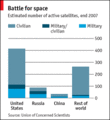
Estimate of the number of active satellites in space (source: Union of Concerned Scientists).
See also: US Space Surveillance Network, "Disharmony in the spheres"

DNA surveys from space
- Whistleblowing scientist Leuren Moret reveals Googles shocking ongoing plans and technology
- DNA surveys from space
Phone tracing
- Todo:
- Mobile phone tracing/triangulation/wiretapping (passive/activated-by-defined-signatures and active/on-demand), identification.
- Mobile phone infrastructure (connection logs, voice/web data)
- VOIP provider data hooks/requests for secret services (Skype, Google Voice, etc.)
Internet
- Todo:
- ISP data-retention/IP-request laws and its enforcement
- Secret services and ISP collaborations
- Credit card purchasing information (privacy, fraud, etc.)
- Web browser cookie issues
- Email taffic espionage (gmail, hotmail)
- Search engine espionage (google)
- Software install espionage (anti-virus software, ...)
- Hardware/appliance espionage (ISP modems, consumer routers/switches, google appliance, ...)
Social networking
- Social Networking Sites and the Surveillance Society
- Pentagon sets its sights on social networking websites
- Profiling/Searching populations through Facebook, MySpace (owned by Rupert Murdoch)
- Security/privacies issues
- Information gleaned from social networks has cost people jobs, led to suspensions and expulsions, damaged prospects for employment and university admission, helped crooks defraud victims and generated criminal charges. Universities scour social networking sites for evidence of residence keg parties, in violation of campus policies. Admissions officers use them to evaluate university-bound students. Police tap into them to investigate underage drinking and sexual activity. Companies check out Facebook to help with direct marketing campaigns. And increasingly, employers are using them to screen prospective employees....“Anything on the site, Facebook can see and data mine,”
- For companies that engage in Datamining “Not only is it a wide range of personal information that’s cross-referenced and verified by the individuals themselves, but people themselves are volunteering this information.”
- Risks associated with the use of social networks
- Data, once published, may remain there forever;
- Traffic data may be shared with third parties, including advertisers and law enforcement agencies;
- Third parties may misuse the data they obtain;
- Photos posted to social networking sites may be connected to facial recognition software and become universal biometric identifiers
- The availability of personal data in user profiles could lead to increased identity theft.
- video: Does what happens in the Facebook stay in the Facebook?
- video: Major Facebook security hole lets you view your friends’ live chats
- video: Julian Assange: Facebook "Most Appalling Spying Machine Ever Invented"
- Identity 'at risk' on Facebook
- Facebook's New Terms Of Service: "We Can Do Anything We Want With Your Content. Forever."
- Quebec police arrest teen for allegedly promoting ethnic hatred on Facebook
Operating Systems
- Backdoors
- Some of the information strikes me as outdated, as I am aware of at least one large nation/economy which has removed Microsoft from its government computer systems and in now Linux-based, using proprietary software. This switchover began in 2004/5. In other words, that country's government was aware of the "backdoor" in Microsoft which allowed the US to spy on them -- and they weren't having it anymore. [4]
Video cameras
Surveillance
RFID systems
(todo)
- In passports, corporate service cards, consumer goods, ...
- Ex-IBM Employee reveals TV Abandoned Analog Band to Make Room for RFID Chips
Entertainment devices
- Digital TV's
- Online game consoles
- Phone-home set-top boxes
Global
Interpol
(todo)
NATO
(todo)
Europe
European Union
- EU INDECT
- "UE FP7 INDECT Project: "Intelligent information system supporting observation, searching and detection for security of citizens in urban environment. Project Description: Intelligent information system supporting observation, searching and detection for security of citizens in urban environment.
- The main objectives of the INDECT project are:
- to develop a platform for: the registration and exchange of operational data, acquisition of multimedia content, intelligent processing of all information and automatic detection of threats and recognition of abnormal behaviour or violence,
- to develop the prototype of an integrated, network-centric system supporting the operational activities of police officers, providing techniques and tools for observation of various mobile objects,
- to develop a new type of search engine combining direct search of images and video based on watermarked contents, and the storage of metadata in the form of digital watermarks,[2].
- The main expected results of the INDECT project are:
- to realise a trial installation of the monitoring and surveillance system in various points of city agglomeration and demonstration of the prototype of the system with 15 node stations,
- implementation of a distributed computer system that is capable of acquisition, storage and effective sharing on demand of the data as well as intelligent processing,
- construction of a family of prototypes of devices used for mobile object tracking,
- construction of a search engine for fast detection of persons and documents based on watermarking technology and utilising comprehensive research on watermarking technology used for semantic search,
- construction of agents assigned to continuous and automatic monitoring of public resources such as: web sites, discussion forums, UseNet groups, file servers, p2p networks as well as individual computer systems,
- elaboration of Internet based intelligence gathering system, both active and passive, and demonstrating its efficiency in a measurable way.[3]
- INDECT partners:
- AGH Univeristy of Science and Technology (Poland) - Project Coordinator http://www.agh.edu.pl/en
- 2. Gdansk University of Technology (Poland) http://www.pg.gda.pl
- 3. InnoTec DATA G.m.b.H. & Co. KG (Germany) http://www.innotec-data.de
- 4. Grenoble INP (France) http://www.grenoble-inp.fr
- 5. MSWIA - General Headquarters of Police (Poland) http://www.policja.pl/
- 6. Moviquity (Spain) http://www.moviquity.com/webingles/index.htm
- 7. PSI Transcom GmbH (Germany) http://www.psi.de/
- 8. Police Service of Northern Ireland (United Kingdom) http://www.psni.police.uk/
- 9. Poznan University of Technology (Poland) http://www.put.poznan.pl
- 0. Universidad Carlos III de Madrid (Spain) http://www.uc3m.es
- 1. Technical University of Sofia (Bulgaria) http://www.tu-sofia.bg
- 12. University of Wuppertal (Germany) http://www.uni-wuppertal.de
- 13. University of York (Great Britain) http://www.york.ac.uk
- 14. Technical University of Ostrava (Czech Republic) http://www.vsb.cz
- 15. Technical University of Kosice (Slovakia) http://www.tuke.sk/tuke?set_language=en&cl=en
- 16. X-Art Pro Division G.m.b.H. (Austria) http://www.x-art.at
- 17. Fachhochschule Technikum Wien (Austria) http://www.technikum-wien.at[4]
United Kingdom
- British SIS (or MI6)
- British Council
- "Private sector language schools with whom the British Council compete complain about the state subsidized competition. While the language teaching makes a profit, the accounting is not transparent and if it were privatized, it is doubtful the it could be promoted in the way it is at present." (wikipedia)
- "For many Russians and, indeed for many people who are suspicious of British motives all over the world, the British Council is an ideal target, not just because it is a symbol of British culture and learning but because it is popularly supposed to be a front for espionage activities." - from: "Its widely assumed that the British Council is a wing of our secret services"
- "Private sector language schools with whom the British Council compete complain about the state subsidized competition. While the language teaching makes a profit, the accounting is not transparent and if it were privatized, it is doubtful the it could be promoted in the way it is at present." (wikipedia)
- MI5
- "MI5, which has a target of increasing its current 3,000 staff to 4,000 by 2011, also insisted that it wanted to improve relations with Muslim communities." [5]
Germany
Italy
- DIS ("Dipartimento delle Informazioni per la Sicurezza" - secret service)
Netherlands
- AIVD
France
- French intelligence constitutes of two major units: the DGSE("In 2009, the DGSE had an estimated staff of approximately 5,000 employees." [6]) the external agency and the DCRI the domestic agency. The latter being part of the police while the former is associated to the army. The DGSE is notorious for the Sinking of the Rainbow Warrior, but it is also known for revealing the most extensive technological spy network uncovered in Europe and the United States to date through the mole Vladimir Vetrov.
- Alexandre de Marenches head of the DGSE was a Knight of Malta. [7]
Spain
- CNI "Centro Nacional de Inteligencia" Employees +/- 2200. The National Intelligence Center (Spanish: Centro Nacional de Inteligencia, CNI) is the Spanish official intelligence agency. Its headquarters are located in the A-6 motorway near Madrid. The CNI is the successor of the Centro Superior de Información de la Defensa, Higher Centre for Defense Intelligence. Its main target areas are North Africa and South America and it operates in more than 80 countries. CNI's budget for 2010 is approximately 255 million euros. [8]
Romania
- CNSAS ("National Council for the Study of Securitate Archives") (Romania)
North America
United States
- See also:
- US secret service IP's: "Now, if you scan these IP addresses, you will find that they all match up...the list is somewhat outdated I suspect, but since they all match up (...) If you trace these IPs most will lead back to "The Internet Access Company" [??], and they also go through Cogent Communications, a Washington DC based tech company that has been doing quite well for being a very young business."
- Todo: Military forts (especially large-scale underground complexes - DUMBs)
NSA
- “The technotronic era involves the gradual appearance of a more controlled society. Such a society would be dominated by an elite, unrestrained by traditional values. (...) The capacity to assert social and political control over the individual will vastly increase. It will soon be possible to assert almost continuous surveillance over every citizen and to maintain up-to-date, complete files, containing even most personal information about the health or personal behavior of the citizen in addition to more customary data. These files will be subject to instantaneous retrieval by the authorities.”-Zbigniew Brzezinski, protegé of David Rockefeller, cofounder of the Trilateral Commission, and NSA to Jimmy Carter, from his 1971 book Between Two Ages[9]
- See also:
CIA
- Reinhard Gehlen also had profound influence in helping to create the National Security Council, from which the National Security Act of 1947 was derived. This particular piece of legislation was implemented to protect an unconscionable number of illegal government activities, including clandestine mind control programs. [10]
- The CIA was founded by William Donovan, a Knight of Malta who had been awarded the highest award in the Roman Catholic Church. The first director of the CIA, Allen Dulles, was a Knight of Malta whose nephew, Avery Dulles, was a prominent Jesuit priest. CIA directors William Colby, William J. Casey, John McCone, Allen Dulles, George Tenet, and Leon Panetta have all been either Knights of Malta or Jesuit-trained. [11]
- National Intelligence Council is small think tank of senior analysts reporting to the Director of Central Intelligence that produces estimates on priority national security issues for the President and his top advisers. [12] by John C. Gannon
- The 1997 CIA budget was 26.6 billion dollars. This year (1998) their budget is $26.7 billion [13]
- HUD’s Missing Money, Catherine Fitts, Hamilton Securities and the CIA.
- The fraudulent movement of finances through HUD were made possible by poor auditing standards that enabled as much as tens of billions of dollars to go annually missing. In a March 2000 report, the HUD (fraud scandal) Inspector General, Susan Gaffney, reported a high number of ‘adjustments’ that had to be made to account for $59 billion that could not be located in 1999 [14]
- video: US Foreign Policy - Secret Wars of the CIA
- Profile: Central Intelligence Agency (CIA) (historycommons.org)
- CIA Plans to Shift Work to Denver
FBI
- The FBI was founded by Charles J. Bonaparte (a grandson of Jérôme Bonaparte, the youngest brother of the French Emperor Napoleon I), a Knight of Malta who served on the board of trustees for the Catholic University of America. FBI directors Louis Freeh and Thomas Pickard are devoutly Roman Catholic and Louis Freeh is an alleged member of Opus Dei. [15]
- See also:
DHS
- Department of Homeland Security (DHS) is a Jesuit operation. The first director was Tom Ridge, a devoutly Roman Catholic Knight of Columbus. The real power behind the DHS was John C. Gannon, the head of it's intelligence unit. Gannon was Jesuit-trained at the College of the Holy Cross and is a member of the Jesuit Volunteer Corps. The deputy director of the DHS from 2005-2007 was Michael P. Jackson, who was Jesuit-trained at Georgetown University. Bush's first pick for the second DHS director was a Roman Catholic man. In the end, he chose Michael Chertoff, who is married to a Jesuit professor (Meryl Chertoff). Under Chertoff, the head of the DHS' immigration was Emilio T. Gonzalez, a Knight of Malta. The new DHS director (Under Obama) is Janet Napolitano, who was Jesuit-trained at Santa Clara University. [16]
Other
- Information Awareness Office - Information-mining technology and mass surveillance system
- DEA
- tolink: ODNI, NIC, NNSA, DOJ, ATF, FINCEN, PFIAB, IOSS, NICX, the U.S. Marshals, Customs, the USPS Postal Inspectors, the Secret Service, Treasury, SBU (Ukraine), ASIS, NZSIS, BND, CSIC, CNI, NBH, ABW, SEID, SISD, the FSB, PRC Intelligence, ROC MJIB, the Japanese Naicho, and all of the U.S., SEATO and ASEAN Defense Departments.
- "Except for the CIA, intelligence offices or agencies are components of cabinet departments with other roles and missions. The intelligence offices/agencies, however, participate in Intelligence Community activities and serve to support the other efforts of their departments." ... "Intelligence Community. The Intelligence Community (defined at 50 U.S.C. 401a(4)) consists of the following:" (from "Intelligence Issues for Congress")
- National Security Agency (NSA)
- National Reconnaissance Office (NRO)
- Central Intelligence Agency (CIA)
- Bureau of Intelligence and Research (INR)
- National Geospatial-Intelligence Agency (NGA)
- Federal Bureau of Investigation (FBI)
- Defense Intelligence Agency (DIA)
- Army Intelligence
- Office of Naval Intelligence
- Air Force Intelligence
- Marine Corps Intelligence
- Coast Guard (CG)
- Treasury Department
- Energy Department
- Drug Enforcement Agency (DEA)
- National Health Intelligence Network (NHIN)
- Bureau of Firearms/xplosives, Tobacco and Alcohol (BFTA)
Canada
- CSIS (Canada)
Israel
Russia
- GRU (1918, created by Jesuit coadjutor Lenin)
- FSB (Russia)
- Foreign Intelligence Service (Russia)
- "KGB's archives affords me a glimpse at Vatican's Intelligence Service":
- "Stanislav Lekarev, a well-placed investigative reporter and a former Soviet official, reveals the results of his heart-to-heart with a friend that still has access to the documents from KGB's 5th Chief Directorate that was also responsible for dealing with religious dissent. Despite the Holy See's curt, Jesuit-like denial of having any involvement in intelligence activities, the archives shed rare light on the Vatican's well-though-thinly-cloaked clandestine activities in USSR. Vatican's Secret Service is a well-compartmentalized into its many cover organizations conveniently subdivided by their religious activities that afford the Holy See the advantages over any other intelligence service. The strategically important service is the responsibility of the Jesuits. The order is under the direct command of the pontiff. The Jesuits manage information-gathering functions for the Vatican. Thus the Russian department is conveniently set up under the cover of the Congregation of the Eastern Churches, Actione Catolica, Russia Christiana, and has its operations center at the St. Georgio Institute in Medona, and at the Modesto Monastery in Seriate, a picturesque suburb of Milan. The department that runs its agents in Russia is the mysterious Russicum [17], which has a legitimate appearance of any other Catholic outreach facility, recruiting into its ranks residents of Eastern Europe. Information gathering takes place under the guise of very conventional missionary activity, a non-governmental charity work, seemingly innocent purchase of a government's archives. The Russian desk is still run by its Vatican's former USSR directorate which bears the name of the St. Teresa Russian Catholic College. The external and hands-on operations are also performed by the Dominican Order. The order uses its international resources to exfiltrate its agents, to discredit undesirable officials, and other cloak and dagger operations. Its low-profile department of Sodalicium Pianium is responsible for internal security, taking care of the Vatican's own heretics, and vetting out Vatican's security apparatus. Thus Vatican has plenty of organizations to also collaborate with other intelligence agencies. Joint projects with CIA, MI6, SDECE and Mossad has been through The Sovereign Military and Hospitaller Order of St. John of Jerusalem of Rhodes and of Malta. Pinochet and the Polish Solidarnosc (Solidarity) are good examples of Vatican's intelligence networking par excellence."
- "Vatican intelligence has spied on Russia for many years"
- [Russia’s Security Service Could Gain Powers Formerly Associated With Soviet KGB]
- Russia’s parliament is considering a new law that would extend the powers of the country’s secret security agency, the FSB. If the bill is passed, it would restore practices once associated with the infamous KGB. Russia’s security services have steadily regained power and influence under Prime Minister Vladimir Putin, himself a former KGB officer. Human rights advocates are concerned that the new measures could further curtail the rights of government critics and the independent media.
- "KGB's archives affords me a glimpse at Vatican's Intelligence Service":
Asia
China
- ...
Pakistan
- ISI
- Many in the Pakistani government, including slain former Prime Minister Benazir Bhutto, have called the intelligence agency "a state within a state," working beyond the government's control and pursuing its own foreign policy. [18]
Literature
 [19] The CIA and the cult of intelligence, Victor Marchetti, ISBN 978-0440203360

 Blank Check: The Pentagon's Black Budget, Tim Weiner, ISBN 978-0446392754

Links
- redactednews.blogspot.com
- "Current US intelligence classifications"
- "The U.S. Domestic Intelligence Enterprise"
- Intellipedia
- "Google has lots to do with intelligence" (March 30, 2008):
- "The system is modeled after Wikipedia, the public online, group-edited encyclopedia. However, the cloak-and-dagger version is maintained by the director of national intelligence and is accessible only to the CIA, FBI, National Security Agency and an alphabet soup of other intelligence agencies and offices. Agents can log in, depending on their clearance, to Intellipedia's three tiers of service: top secret, secret and sensitive but unclassified. So far, 37,000 users have established accounts on the network, which contain 35,000 articles encompassing 200,000 pages, according to Dennehy. Google supplies the computer servers that support the network, as well as the search software that allows users to sift through messages and data."
- "Google has lots to do with intelligence" (March 30, 2008):
- AxisGlobe eastern secret service news.
- CACI:
- "A publicly held Information Technology (IT) company, headquartered in Arlington, Virginia and London, England. CACI provides national security, defense, and intelligence-related solutions in the national interest of the United States to counter the threat of global terrorism, assure homeland security, and strengthen the company’s role as a national asset for national missions. CACI has approximately 11,800 employees in 120 offices in the US and Europe; 69% of CACI employees hold security clearances."
- Richard Armitage was a former Deputy Secretary of State and former board member of CACI, the private military contractor whose employees were responsible for torturing prisoners at Abu Ghraib prison.
- See also: "Richard Armitage and CACI"
